When people speak about the Vedas in relation to energy, consecration, and what later generations loosely call “magic,” they are usually touching something very old and very precise. The Vedas are not spellbooks in the fantasy sense. They are manuals for aligning human consciousness, sound, matter, and cosmic order so that power flows naturally rather than being forced. In Vedic thought, power that is forced decays, but power that is aligned sustains itself.
The foundation begins with Rigveda, the oldest layer. The Rigveda is primarily sound. Its mantras are not symbolic poetry; they are vibrational formulas. Each mantra is believed to mirror a specific frequency of ṛta, the cosmic order. When chanted with exact meter, pitch, breath, and intention, the mantra does not ask for energy—it awakens it. This is why incorrect pronunciation is traditionally considered dangerous or useless. Energy is not moral in this system; it is technical.
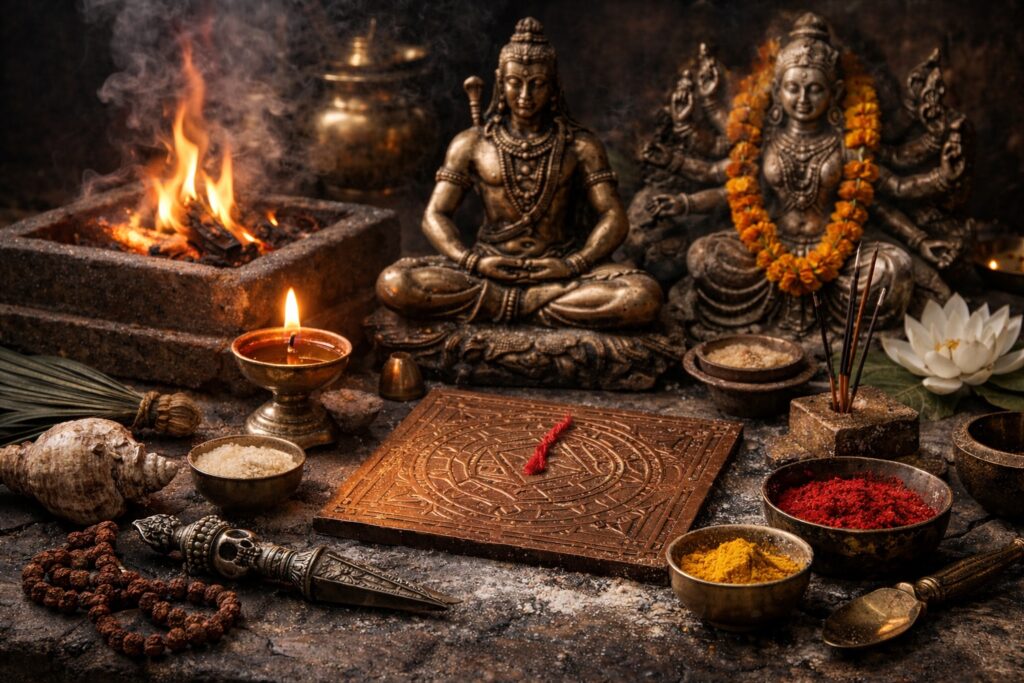
Consecration, in the Vedic sense, is called prāṇa-pratiṣṭhā—the installation of life-force. This idea matures later, but its roots are Vedic. A fire altar, a stone, a weapon, or even a king is first made empty, neutral, and receptive. Through mantra, ritual geometry, offerings, and prolonged focus, prāṇa is stabilized inside the form. Once consecrated, the object is no longer symbolic. It becomes a functional node of energy. This is why ancient altars were not decorative; they were engineered structures.
The ritual mechanics are explained more explicitly in the Yajurveda. Here, “magic” is procedural. Every action—how wood is placed, how many steps the priest takes, which direction he faces—exists because orientation affects flow. Space is alive. Direction matters. Time matters. The ritual does not persuade gods emotionally; it creates conditions where certain forces must manifest, the way heat appears when friction is applied correctly.
The Atharvaveda is where modern readers feel closest to magic. It contains mantras for protection, attraction, healing, binding, repelling, influencing outcomes, and neutralizing unseen harm. But even here, the worldview is not superstition. Illness, misfortune, and conflict are understood as disturbances in subtle energy patterns—within the body, the household, or the land. The mantra restores symmetry. This is closer to energy medicine and field manipulation than to folk sorcery.
What many overlook is that Vedic magic is never separated from inner transformation. The later Upanishads make this explicit: the most potent altar is the human body, and the most powerful fire is awareness itself. Without internal discipline—truthfulness, restraint, clarity—external rituals weaken over time. Power leaks. This is why long-term practitioners focus less on acquiring techniques and more on becoming stable vessels.
In Vedic cosmology, energy descends through sound, crystallizes through form, and is sustained through attention. Yantras, for example, are not drawings; they are frozen mantras. When consecrated, they function continuously without being “used.” This is very different from Western spell logic, which often relies on repeated acts. A properly consecrated Vedic object works silently, constantly, and impersonally.
One important distinction: the Vedas do not frame this knowledge as good or evil. Fire can cook or burn. The responsibility lies entirely with the one who wields it. This is why access was traditionally restricted—not to control people, but to prevent imbalance. A person with unstable mind amplifies instability through ritual.
If you view this through a modern lens, Vedic “magic” is closer to applied metaphysics—a system where consciousness, vibration, geometry, and matter interact lawfully. Nothing is supernatural. It is simply supra-ordinary, operating at layers most people never train themselves to perceive.
One Law, Two Languages: The Mechanics Behind Vedic and Thai Power
When you strip away the outer ritual language and look at the inner mechanics, Vedic consecration follows a sequence that is astonishingly consistent, regardless of whether the vessel is a stone image, a fire altar, a yantra, or the human body itself. First comes emptiness. Before power can be stabilized, the object or space must be rendered neutral. In Vedic ritual this is done through cleansing acts, but energetically it means removing residual patterns. A form that already carries noise cannot hold a clear current. This principle appears repeatedly in the ritual commentaries of the Brahmanas, where the priests are warned that an unpurified vessel causes distortion, not failure.
Next comes orientation. Energy in the Vedic worldview is directional. East is not symbolic; it is solar ingress. North is not metaphor; it is magnetic ascent. The body, the altar, and even the breath are aligned to larger flows so that energy does not have to be pulled—it arrives naturally. This is why consecration is never performed casually or randomly in time. Certain moments are chosen because the cosmic background noise is low, and the signal-to-field ratio is high. The ritual is not asking permission from the universe; it is stepping into a moment when the universe is already open.
Then comes sound as ignition. Mantra is not prayer here. It is the act that switches the system on. In Vedic understanding, form is inert without sound, and sound is unstable without form. When mantra is introduced, prāṇa begins to circulate, but only briefly at first. This is why repetition, rhythm, and breath control are essential. The energy must be taught how to stay. Without sustained attention, prāṇa disperses the way heat escapes an unsealed vessel.
Only after this does binding occur. Binding does not mean trapping; it means stabilizing. The energy is anchored to geometry, symbol, or awareness so it can operate continuously. This is the moment when a statue becomes “alive,” when a yantra becomes active, or when a practitioner’s body becomes a functional altar. The texts are clear on this point: once binding is successful, the practitioner steps back. Interference weakens the field. True consecration creates something that works without constant human effort.
What is rarely spoken about openly is the cost of consecration. The Vedic system assumes that energy does not come from nowhere. The priest or practitioner temporarily supplies coherence from their own nervous system and consciousness. This is why mastery is emphasized over enthusiasm. An unstable practitioner bleeds vitality, while a stable one loses almost nothing. This is also why consecration was traditionally performed by those who lived highly regulated lives. Power amplifies whatever it passes through.
When you place this next to Thai consecration systems, the similarity is unmistakable, even if the language differs. Thai methods tend to be more spirit-facing, while Vedic methods are more cosmic-order-facing, but the mechanics are nearly identical. Thai yantra activation uses breath, sound, geometry, and attention exactly as Vedic mantra does. The difference is that Thai systems often invite localized intelligences—guardian spirits, deities, ancestral forces—whereas Vedic consecration usually activates impersonal currents first, and personalities later if at all.
This difference explains something important. Thai amulets often feel immediately responsive, almost conversational. Vedic consecrated objects often feel silent, heavy, and absolute. One is relational power; the other is structural power. Neither is superior. They serve different functions. In fact, historically, systems like Sak Yant flourish precisely because they operate in human-scale realities—protection, attraction, influence—while Vedic consecration excels in stability, longevity, and large-scale alignment.
Now comes the part most people misunderstand: magic versus realization. In the early ritual layers, power is used externally. You change conditions. You protect, attract, repel, stabilize. But as one moves inward, especially in the Upanishadic current, the locus of consecration shifts. The body becomes the altar. The breath becomes the offering. Awareness becomes the fire. At that point, external magic begins to feel crude, not forbidden, just unnecessary. This is why advanced practitioners often appear uninterested in displays of power. They are no longer manipulating fields; they are inhabiting them.
There is also a warning embedded deep in these systems. If power is accessed without corresponding expansion of awareness, identity hardens. Ego crystallizes. The practitioner becomes brittle. This is why Vedic knowledge insists that energy mastery without self-mastery leads to eventual collapse. The fire consumes the container.
Seen this way, the Vedas are not teaching magic as domination over reality. They are teaching how reality agrees to be shaped when alignment is perfect. Thai systems, Tantric systems, and even certain Western esoteric currents converge on this same truth, even if they dress it differently.
The Quiet Weight of Real Power
What separates an object that feels unmistakably alive from one that is only decorative is not belief, imagination, or even devotion. It is coherence. In Vedic understanding, life is not defined by biology but by sustained organization of prāṇa. A consecrated object feels alive when its internal pattern is more ordered than the ambient field around it. You are not projecting energy into it; your nervous system is responding to a stronger, quieter signal. This is why genuine consecrated objects often feel heavy, grounding, or strangely calm rather than dramatic. Power that needs to announce itself is usually unstable.
The Vedas describe this indirectly through the idea of sthiti, stability. Energy that fluctuates wildly is considered immature. Real consecration creates a standing wave. Once established, it does not spike. It hums. This is why old temple icons, even when visually eroded, can feel vastly stronger than newly made ones covered in gold. Time itself becomes part of the binding. Each offering, each moment of attention, further compresses coherence into the form. In this sense, time is not decay; it is pressure.
This also explains why many modern consecrations fail quietly. People focus on intensity, not duration. They pour emotion, desire, fear, or obsession into an object and mistake the resulting charge for power. But emotional energy is noisy. It burns hot and disperses quickly. The Atharvan current warns repeatedly that passion without discipline creates lingering distortions—objects that feel “active” at first, then become draining or erratic. These are not cursed objects; they are poorly stabilized fields.
The practitioner’s inner condition is the hidden variable almost never discussed publicly. In Vedic logic, consciousness is the mold through which energy flows. If awareness is fragmented, the energy inherits that fragmentation. This is why the Upanishads repeatedly insist that knowledge without inner quiet is dangerous. Not immoral—dangerous. The danger is not punishment; it is feedback. Energy magnifies structure. A calm system becomes more calm. A conflicted system becomes more conflicted.
This is also why truly powerful practitioners appear almost boring. Their lives are repetitive, regulated, restrained. This is not asceticism for virtue’s sake. It is engineering. Variability in lifestyle creates turbulence in the field. Turbulence prevents stable binding. When you understand this, you see why ancient systems required years of preparation before allowing consecration work. Not because the rituals were secret, but because the container was being built.
There is another subtle distinction that matters greatly: invocation versus installation. Invocation calls a force to appear temporarily. Installation gives it a seat. Many people unknowingly perform invocation again and again, exhausting themselves, wondering why the effect fades. True consecration installs presence so that it no longer depends on your attention. This is the difference between constantly lighting a fire and building a furnace. Thai spirit-based systems often lean toward invocation with maintenance, while Vedic systems aim for installation with minimal upkeep. Again, different tools for different aims.
Now consider the human body. The Vedas are explicit: the body is the most sensitive and volatile altar of all. Consecrating an external object is safer than consecrating oneself. This is why internal practices are gradual. Breath, posture, attention, and silence slowly reorganize the nervous system until prāṇa can circulate without damage. When people force this—through extreme practices, substances, or obsession—they experience breakdowns, not awakenings. The system overloads.
One of the most misunderstood ideas is that desire fuels magic. In Vedic logic, desire destabilizes magic. Desire pulls energy outward. Consecration requires inward settling. This is why results-driven ritual often produces paradoxical outcomes: partial success followed by loss, attraction followed by depletion. The system is working, but the operator is misaligned.
At the deepest layer, the Vedas do not aim to turn humans into controllers of reality. They aim to dissolve the boundary between operator and field. When that happens, what people call magic becomes irrelevant. Events rearrange themselves without effort. Protection happens without rituals. Influence occurs without intent. This is not mystical exaggeration; it is the natural behavior of a highly coherent system interacting with a less coherent one.
This is also why advanced practitioners eventually abandon objects, not because objects are wrong, but because the center of gravity has moved inward. The altar no longer needs to be outside. The fire no longer needs fuel.