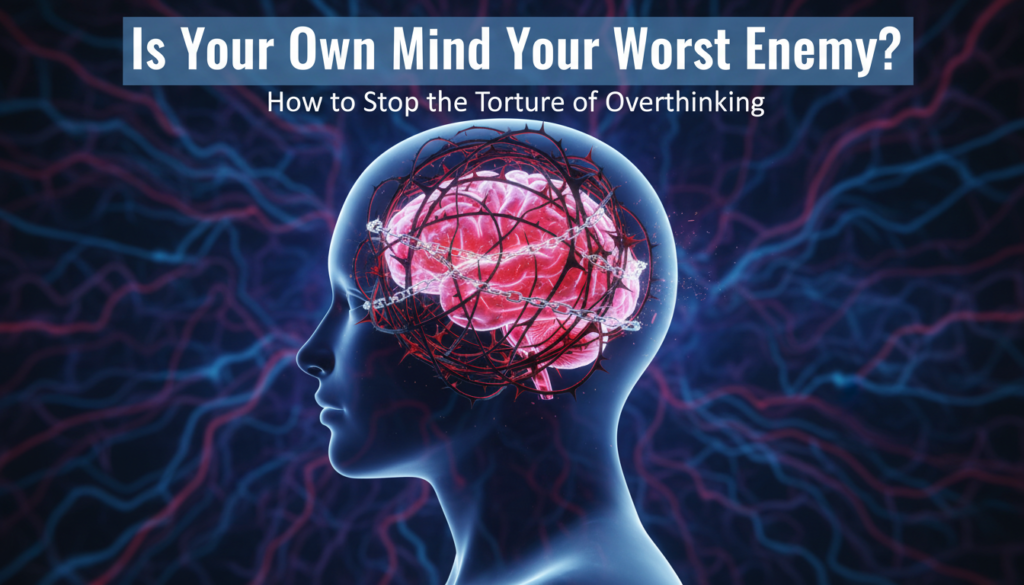
The mind is a beautiful servant but a dangerous master. You have heard this many times, but have you ever felt the weight of it in your own bones? You sit in a quiet room, the sun is setting, the birds are returning to their nests, and there is a profound silence in the existence. But inside you, there is no sunset, and there are no nesting birds. There is only a marketplace—a chaotic, loud, and relentless noise of thoughts. You are overthinking. You are analyzing the past which is no more, and you are planning for a future which has not yet arrived. In this process, you are missing the only thing that is real: this very moment, this very breath.
To understand the torture of overthinking, you must first understand what the mind is. The mind is not you. It is a mechanism, a biological computer that you have inherited through millions of years of evolution. It is a collection of memories, conditioning, and social programming. It was designed to help you survive in the jungle, to avoid the tiger, and to find food. But the tiger is gone, and the mind has nothing to do. So, it turns upon itself. It begins to eat you. It begins to weave webs of “what if” and “should have.” This is the tragedy of modern man: we have developed the intellect, but we have completely forgotten how to be silent.
The Mechanism of the Internal Noise
Why does the mind keep talking? It is because the mind is a tension. It exists only when there is a problem to solve. If there is no problem, the mind feels threatened; it feels it might disappear. So, if there are no real problems, the mind creates imaginary ones. It creates a drama out of nothing. You are walking down the street, someone looks at you in a certain way, and your mind begins: “Why did he look at me like that? Did I do something wrong? Is there something on my face? Maybe he knows something about me that I don’t know.”
This is not thinking; this is a disease. Real thinking is a tool. When you want to solve a mathematical problem, you use the mind. When the problem is solved, you put the mind aside. But you have forgotten how to put it aside. It has become a constant companion, a ghost that haunts you day and night. Even when you go to sleep, the mind continues. It calls it dreaming. It is the same noise, just in a more chaotic, symbolic form.
The Illusion of Productivity
Many people believe that overthinking is a sign of intelligence. They think that by worrying, they are being responsible. They think that if they analyze a situation ten thousand times, they will find the perfect solution. But intelligence and intellect are two very different things. Intellect is the ability to analyze, to dissect, to divide. Intelligence is the ability to see the whole, to see the reality as it is. Overthinking is the death of intelligence because it keeps you caught in the parts. You are so busy looking at the trees that you never see the forest. You are so busy analyzing the notes that you miss the music.
The overthinker is like a man who wants to walk but is so worried about which foot to put forward first that he becomes paralyzed. He studies the anatomy of the foot, the gravity of the earth, and the friction of the floor. He has all the knowledge, but he cannot take a single step. Life is meant to be lived, not analyzed. Analysis is for the dead; life requires an integrated response, a total jump into the unknown.
The Ego’s Need for Drama
The ego thrives on overthinking. The ego is nothing but a shadow, and a shadow needs darkness to exist. Overthinking creates that darkness. When you are worried, when you are in conflict, when you are stressed, the ego feels very solid. It feels like “I am.” When you are silent, when you are blissful, when you are in deep meditation, where is the ego? It disappears. This is why you are afraid of silence. This is why you keep the inner chatter going—because you are afraid that if the noise stops, you will die.
And in a way, you are right. The “you” that you think you are—the personality, the ego, the bundle of memories—will indeed die in silence. But that which is real in you, your true essence, your soul, can only be found when the noise stops. The torture of overthinking is actually the ego’s way of maintaining its grip on your consciousness. It keeps you in a state of constant friction, for without friction, the ego cannot be felt.
The Trap of the Past and the Future
The mind can only exist in two places: the past or the future. It cannot exist in the present. In the present, there is only existence. But the mind needs time. Overthinking is the process of moving back and forth between what was and what will be. You think about a mistake you made ten years ago, and you feel the guilt today. Or you think about a possible failure tomorrow, and you feel the anxiety today. You are being tortured by things that do not exist! The past is a memory; the future is a dream. Both are non-substantial. Yet, you sacrifice the reality of the present for these two shadows.
- The Past: A graveyard of memories. To overthink the past is to try and revive the dead. It is a futile exercise that only brings misery.
- The Future: A projection of the past. Your “what ifs” are usually based on what has already happened. To overthink the future is to be afraid of a ghost that hasn’t even been born.
- The Present: The only door to the divine. It is narrow, and you cannot carry your baggage of thoughts through it.

The Difference Between Thinking and Witnessing
The solution to overthinking is not to stop thinking. You cannot stop it by force. If you try to stop the mind, you will only create more noise. It is like trying to settle a muddy pond by hitting the water with a stick. You will only make it muddier. You must learn a different art: the art of witnessing. You are not the mind; you are the observer of the mind. This is the most revolutionary realization a human being can have.
When a thought arises, do not fight it. Do not judge it as good or bad. Do not try to change it. Just watch it. Let it pass by like a cloud in the sky. If you are sitting by the side of a road, you watch the traffic. A car goes by, then a truck, then a motorcycle. You don’t jump in front of the truck to stop it. You don’t run after the car because it is beautiful. You just sit on the grass and watch. This is the quality of witnessing.
Creating the Gap
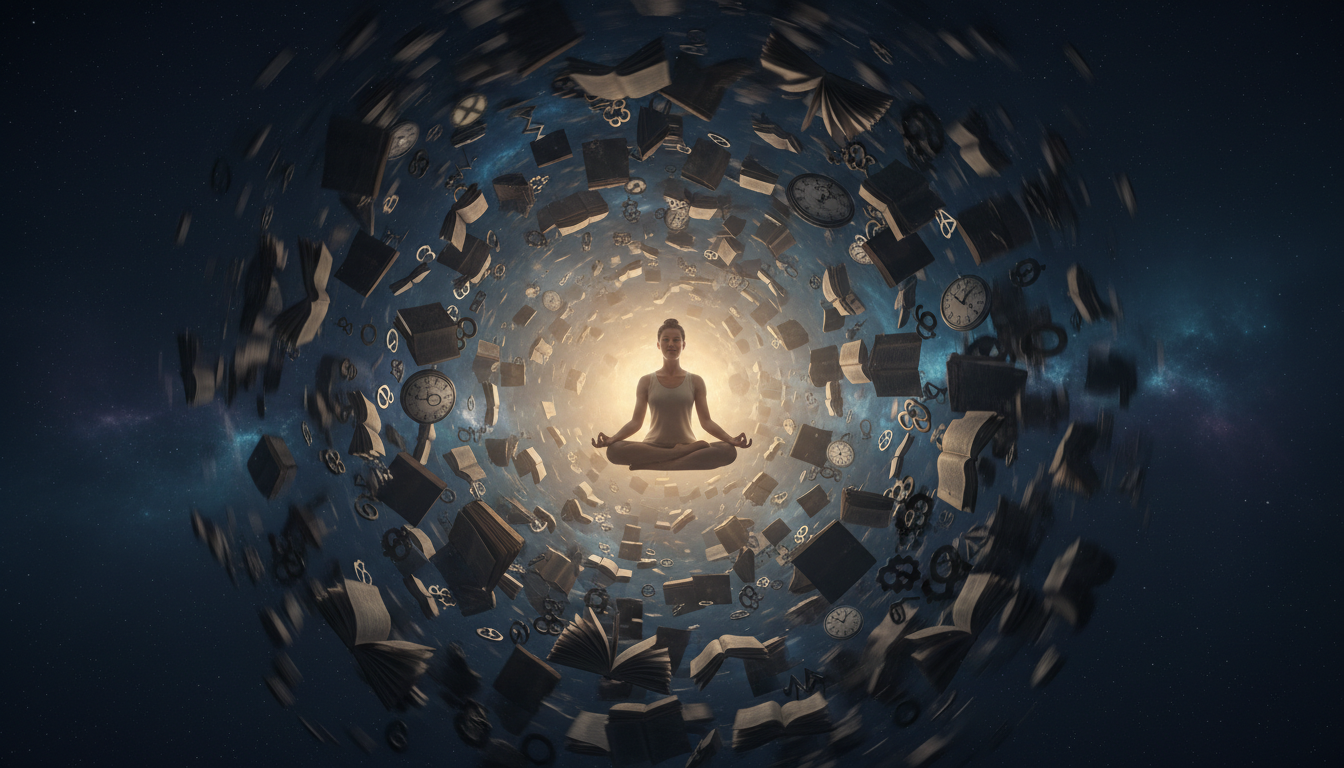
In the beginning, you will find that as soon as you watch a thought, you get caught in it. You start watching a thought about a friend, and suddenly you are thinking about a conversation you had, and then you are back in the cycle. This is natural. Just gently come back to the observer. Slowly, slowly, you will start to notice something beautiful: a gap. A thought comes, and then there is a small interval of silence before the next thought arrives. In that gap, you are. In that gap, there is no overthinking. In that gap, you are connected to the source of life.
The goal is not to become thoughtless, but to become so aware that the thoughts no longer have power over you. They become like the noise of the traffic outside your window. It is there, but it doesn’t bother you. You are at home, in your own silence.
How to Stop the Torture: Practical Awareness
While the ultimate solution is witnessing, there are practical ways to bring yourself back to reality when the mind starts its torture. These are not techniques to “fix” the mind, but ways to ground yourself in the body, which is always in the present.
Returning to the Senses
The mind is abstract; the senses are concrete. When you find yourself caught in a loop of overthinking, immediately shift your attention to your senses. What can you smell right now? What can you hear? What is the texture of the chair you are sitting on? Feel the weight of your body against the earth. The body cannot be in the past or the future. By bringing your awareness to the body, you force the mind to come back to the “now.”
The Power of Breath
The breath is the bridge between the body and the soul. When you are overthinking, your breath becomes shallow and erratic. By consciously slowing down the breath, you signal to the nervous system that there is no danger. Breathe in deeply, and as you breathe out, imagine that you are exhaling all the unnecessary thoughts. Do not try to think your way out of thinking; breathe your way into being.
- Watch the inhalation: Feel the cool air entering the nostrils.
- Watch the pause: There is a tiny moment where the breath stops before turning back. This is a moment of pure silence.
- Watch the exhalation: Feel the warm air leaving the body, carrying away the tension.

Intelligence vs. Information
We live in an age of information overload, which provides the mind with infinite fuel for overthinking. We are constantly bombarded with news, opinions, and data. The mind takes all this garbage and tries to process it, creating a state of perpetual indigestion. Real intelligence is the capacity to discard the junk and keep only what is essential. An overthinker is a hoarder of useless information. A wise man is one who knows how to forget.
If you want to stop the torture, you must stop feeding the machine. Spend time in nature where there is no “information.” The trees do not have opinions about you. The mountains are not worried about the economy. In the company of nature, your own naturalness begins to surface. You realize that the universe is functioning perfectly well without your constant worrying. The stars are moving, the seasons are changing, and your heart is beating—all without any help from your overthinking mind.
The Courage to Be Uncertain
One of the root causes of overthinking is the fear of being wrong. We want to be certain before we act. But life is an adventure, and adventure means uncertainty. Only the dead are certain. The more you try to be certain, the more you will overthink. If you can accept that life is a mystery, that you don’t have all the answers, and that it is okay to make mistakes, the overthinking will lose its grip. Courage is not the absence of fear or doubt; it is the ability to move through them.
The Transformation of Energy
Overthinking is a huge waste of energy. When you think, you are leaking life force. This is why you feel so exhausted after a day of “doing nothing” but worrying. That same energy, if channeled correctly, could become creativity, it could become love, it could become meditation. When you find yourself overthinking, recognize it as a surplus of energy that has nowhere to go. Instead of letting it spin in your head, give it a direction. Dance, sing, run, paint—do something that involves your whole being. When you are totally involved in an activity, the thinker disappears and only the doing remains. This is the state of “flow,” and it is the antidote to the mind.
Living in the Present Continuous
Don’t make it a goal to “stop overthinking” by next Tuesday. That will only give the mind something else to think about. Just make it a practice to be more aware in each moment. If you are drinking tea, just drink the tea. Don’t think about the bills you have to pay. Feel the warmth of the cup, the aroma of the leaves, the taste on your tongue. If you are walking, just walk. Let the feet do the walking, and you just be the witness. Life is a series of small moments. If you can be present in each small moment, the big problem of overthinking will simply evaporate.
Conclusion: The Silence is Your True Nature
Ultimately, you are not the torture, and you are not the tortured. You are the space in which both appear and disappear. You are the silence that precedes the thought and the silence that remains after the thought has gone. This silence is not something you have to create; it is your very nature. You have only covered it with a thick layer of dust. The torture of overthinking is just a call to come back home, to return to the center, to stop being a guest in your own house and start being the master.
The next time the mind begins its circus, just smile. Don’t take it seriously. The moment you laugh at the mind, you have transcended it. Laugh at the absurdity of this tiny mechanism trying to figure out the vast, infinite mystery of existence. In that laughter, the mind will stop for a second. And in that second, you will see the truth: you are free, you have always been free, and the only chains you carry are the ones you have forged out of your own thoughts.
Be silent. Be still. Let the mind chatter all it wants, but you remain an unperturbed witness. This is the end of the torture. This is the beginning of life.