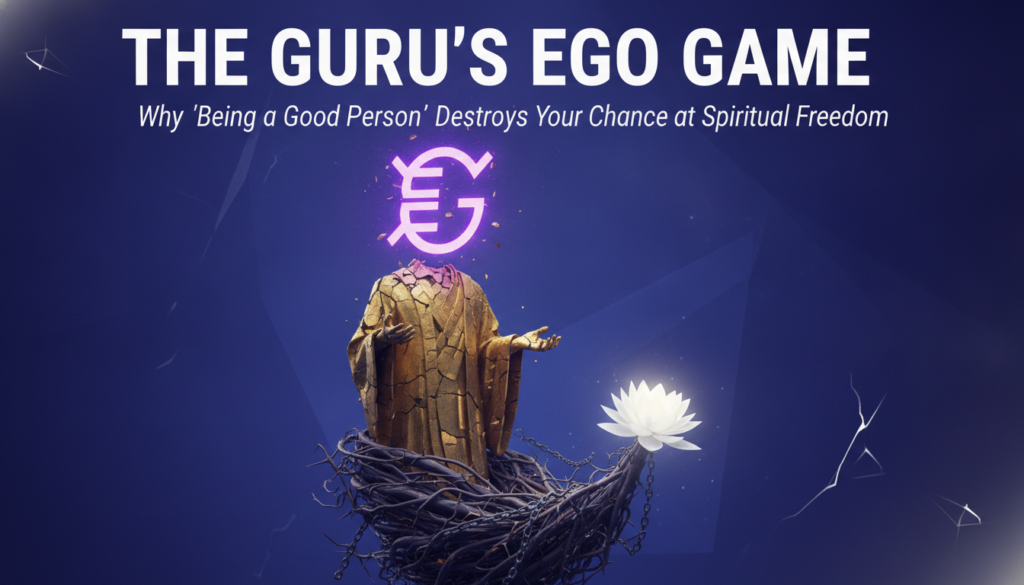
The pursuit of being a “good person” is perhaps one of the most subtle yet potent traps on the spiritual path. It sounds counter-intuitive, even blasphemous to some, but this deep-seated desire to adhere to moral codes, to be perceived as virtuous, is often the very force that shackles you to the ego and prevents true liberation. It is not about actual action, but about the *identity* you forge around those actions.
The Trap of the Golden Cage
The Social Construct of Good
What does it mean to be “good”? This definition is rarely your own. It’s a construct handed down by society, religion, family, and culture. It’s a collection of rules, expectations, and ideals designed to maintain social order, not to foster individual spiritual awakening. You learn early on that certain behaviors are rewarded with approval and acceptance, while others lead to condemnation or isolation. So, you begin to perform, to sculpt yourself into an acceptable image.
This image becomes your golden cage. You are trapped not by chains of suffering, but by the glittering bars of your own perceived virtue. The effort to uphold this image, to consistently meet external standards, consumes your energy and attention, diverting you from the only real journey: the inward one.
Goodness as a Barrier, Not a Bridge
The Unconscious Motivation
Why do you strive to be good? Dig deep. Is it truly a spontaneous outflow of your being, or is there an underlying agenda? Do you fear punishment – social, spiritual, or karmic – if you are not good? Do you desire reward – heaven, respect, self-righteousness, or a feeling of moral superiority? If your goodness is motivated by fear or desire, it is a transaction, not a transformation. It is a calculation, not a flowering.
The moment you declare, “I am a good person,” you have created an identity, a boundary. This identity becomes a shield against self-inquiry. How can a “good person” have anger, jealousy, lust, or dark thoughts? To maintain the image, these aspects of yourself are suppressed, denied, and pushed into the unconscious. You split yourself into an acceptable front and a hidden shadow. Spiritual freedom, however, demands wholeness, the fearless integration of all aspects of your being.
Your “goodness” often prevents you from truly looking at your own motivations, your own unconscious patterns. If you believe you are already good, there is no need for deeper exploration, no urgent call to awaken to who you truly are beyond these labels. It becomes a comfortable resting place for the ego, a very clever disguise.
Beyond Good and Evil: The Path to Freedom
The Witnessing Consciousness
True spiritual freedom is not about ascending to a higher moral plane; it is about dissolving all planes, all judgments, all identities. It is about becoming a pure witness to life, to your own thoughts, emotions, and actions, without labeling them as good or bad. When you observe without judgment, you create a space for understanding and transformation. You see things as they are, not as they should be.
Dropping the mask of “goodness” is terrifying for many, because it means letting go of a carefully constructed identity. But it is only when you are willing to stand naked, in all your raw, messy humanity, that freedom becomes possible. This is not an invitation to become reckless or immoral; it is an invitation to authenticity. When you are truly authentic, your actions arise from a place of deep awareness, not from a prescribed code of conduct.
A truly free being acts not from moral compulsion, but from an inner understanding, from compassion that arises naturally, not from a rulebook. Their actions are spontaneous responses to life, not calculated efforts to maintain an image or earn a reward. They simply are, and their being naturally unfolds in harmony with existence.

The Paradoxical Nature of True Virtue
Action Without Attachment
When you transcend the need to *be* a “good person,” a profound shift occurs. Your actions might outwardly align with what society calls good – kindness, generosity, compassion – but the *motivation* is entirely different. There is no longer an expectation of return, no self-congratulation, no subtle reinforcement of the ego. The action simply happens, because it is the natural, spontaneous response of a conscious being in that moment.
This is where true virtue lies: not in performance, but in authenticity. It is not about projecting an image, but about being whole, which includes acknowledging and integrating all aspects of yourself – the light and the shadow. It is in this wholeness, this acceptance of yourself without qualification, that spiritual freedom truly blossoms.

So, cease your efforts to be a “good person.” Instead, focus your energy on becoming conscious. Observe your motivations, your fears, your desires, without judgment. Be willing to dismantle the structures of your ego, even the ones built with the most noble intentions. Only when you drop the burden of being “good” can you truly discover the boundless freedom of simply being.