Most people live their lives within the narrow confines of what they can see, touch, and smell. They think that if a thing cannot be measured by a laboratory instrument, it does not exist. This is a very unintelligent way to exist. Your five senses are evolved for one purpose only: survival. They tell you where the food is and how to avoid being eaten. They are not windows into the nature of reality. In the Thai tradition, there has always been a deep realization that your physical home is superimposed upon a much more complex web of energetic dimensions. If you ignore these dimensions, you are essentially living in a house with the doors and windows wide open, wondering why the wind is blowing your papers around.
The Thai occult, is not a religion. It is a technology. It is a set of tools designed to manipulate the unseen forces of the atmosphere to create a specific result. Usually, that result is protection, prosperity, or the stabilization of one’s own life force. When we speak of “forbidden” rituals, we are not talking about something evil. We are talking about knowledge that was kept away from the casual seeker because, like any high-powered tool, if you do not know how to handle it, you will hurt yourself. If you try to play with a high-tension electrical wire without insulation, the result is predictable. The occult is the same.
The Mechanics of Unseen Energy
Before you bring any ritual into your home, you must understand the basic logic of how these things work. Your home is a container. Just as a cup holds water, the walls of your house hold an energetic quality. If you are constantly angry, fearful, or anxious, you are literally soaking the walls with that quality. Eventually, the house starts giving that back to you. You walk into the house and feel tired for no reason. This is not a ghost; it is just the residual memory of your own nonsense. However, there are also external influences—other people’s intentions, environmental imbalances, and disembodied energies that naturally gravitate toward human dwellings.
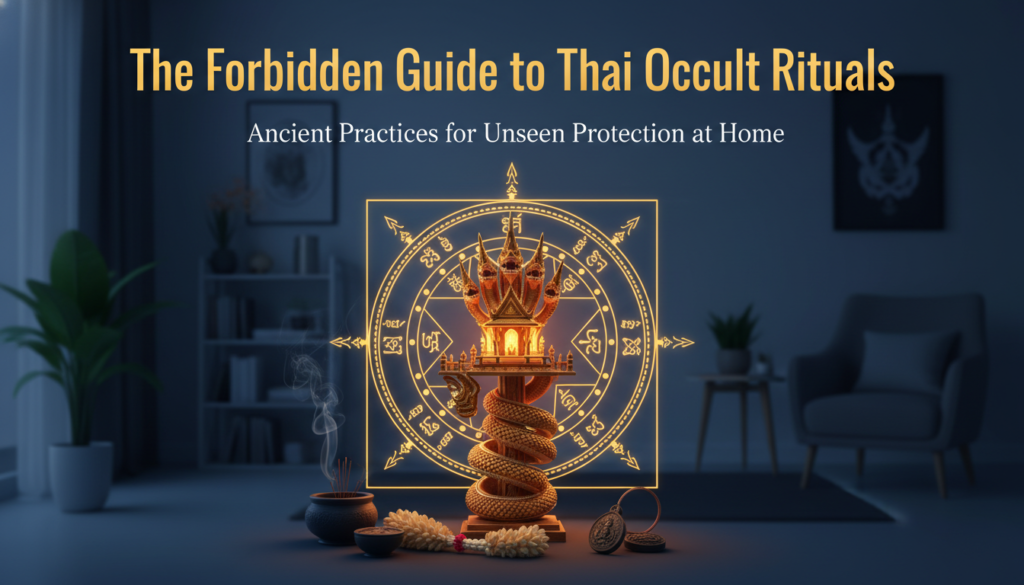
The Thai system of protection uses three main pillars: the guardian of the land, the sacred geometry of the Yantra, and the consecrated object or amulet. These are not decorative items. They are tuning forks. They are meant to set a vibration in the house that is so high or so specific that lower-frequency “noise” simply cannot enter. It is like turning on a very bright light in a room; the darkness doesn’t have to “leave,” it just ceases to be.
The Spirit House: Negotiating with the Land
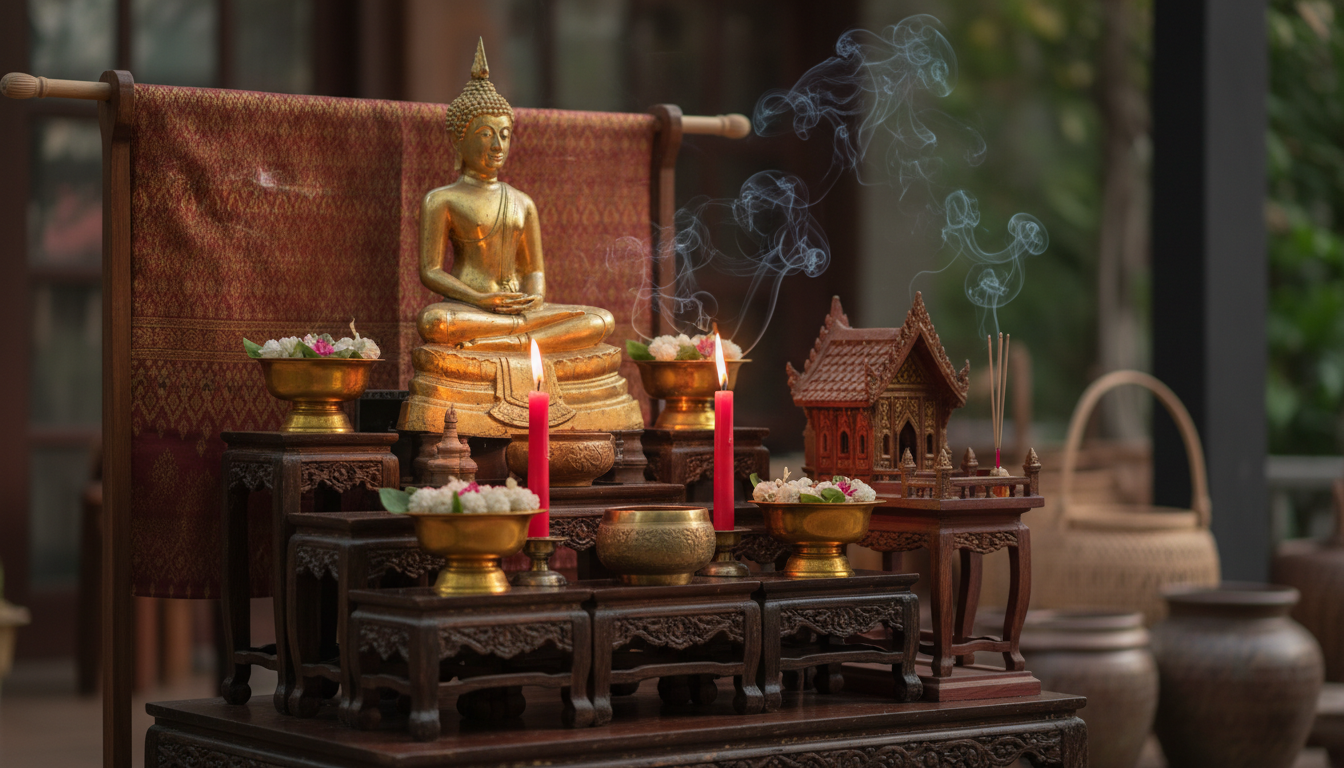
One of the most misunderstood aspects of Thai culture is the San Phra Phum, or the Spirit House. You will see these small, ornate structures outside almost every home and business in Thailand. People think it is for “ghosts.” This is a very shallow understanding. Every piece of land has an original inhabitant, an energetic blueprint that was there long before you decided to build a concrete box on top of it. When you build a house, you are displacing that energy.
San Phra Phum and the Phra Chai Mongkol
The Spirit House is essentially an act of diplomacy. You are acknowledging that you are not the true owner of the land; you are merely a guest. By installing a San Phra Phum, you are providing a dedicated space for the “Lord of the Land” (Phra Chai Mongkol). When this entity is respected and “housed,” it acts as a gatekeeper. It ensures that no wandering energies or malicious intent from the outside can cross the perimeter of your property. If you live in an apartment where you cannot place a structure outside, the ritual is modified to an internal altar, but the intent remains the same: you must pay “rent” to the space you occupy through daily recognition.
Offerings as Energy Transfer
People often ask why spirits need water, flowers, or incense. They don’t “eat” the food. What is happening is an energy transfer. The freshness of the flowers, the fragrance of the incense, and the purity of the water are all qualities of the physical world that act as a bridge. It is a way of keeping the connection between the physical and the non-physical active. If you stop the ritual, the bridge collapses, and you are back to being a vulnerable organism in a chaotic world.
The Technology of the Yantra
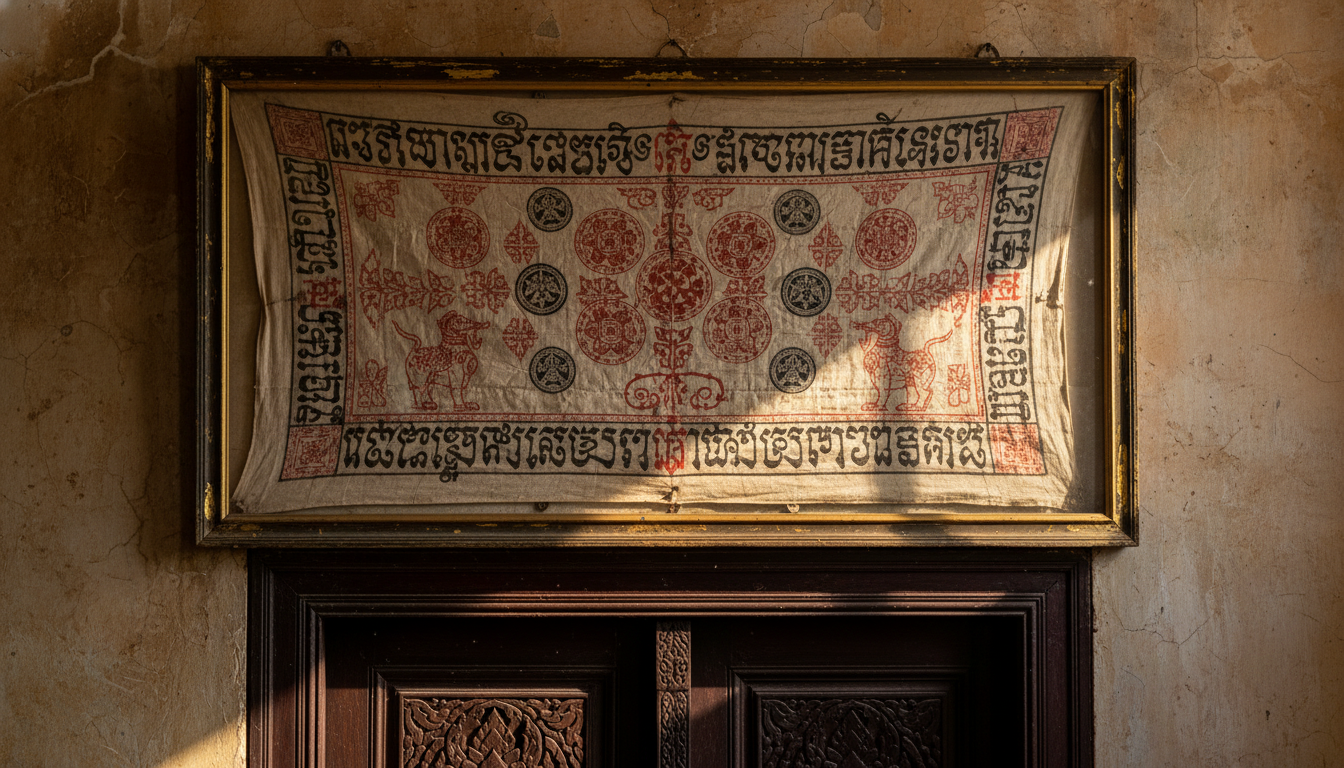
In the Thai occult, geometry is sacred. We call this Sak Yant when it is on the body, but for the home, it is often written on cloth (Pha Yant) or carved into wood and metal. These are not just drawings. They are complex mathematical formulas expressed visually. They work on the same principle as a satellite dish. The shape of the dish determines what kind of signal it can catch. The shape of a Yantra determines what kind of energy it radiates into a room.
Yant Thao Wessuwan for Protection
If you are looking for protection against “black magic” or unseen entities, the most powerful figure in the Thai pantheon is Thao Wessuwan. He is the King of the North and the ruler of all demons and spirits. Having his Yantra or his image at the entrance of your home is like having a high-ranking general standing at your door. Any lower-level entity that tries to enter will immediately recognize his authority and turn away. This is not about belief; it is about the hierarchy of the energetic world.
Placement and Activation
A Yantra is useless if it is treated like a poster. It must be placed above the eye level, usually over the main doorway. In the Thai tradition, the “top” of things is sacred. You should never place these symbols near the floor or in a place where people will walk over them. To activate it, you use a “Katha”—a specific sound vibration. Sound is the fastest way to change the quality of a space. By chanting a specific sequence of syllables, you “plug in” the Yantra to the source it represents.
The Role of Amulets: Portable Batteries
Many people carry Thai amulets, but they also serve as “batteries” for the home. An amulet is an object—usually made of sacred powders, metals, or herbs—that has been subjected to intense meditative focus by a practitioner. This focus “charges” the object with a specific intent. If you have an amulet of a high-energy master like Luang Phor Thuad or a Phra Pidta, it acts as a constant stabilizer for the room it is in.
Why Amulets Fail
People often complain that their amulets “do not work.” This is because they treat the amulet like a lucky charm. If you are living a life of total chaos, if you are lying, stealing, and creating misery for others, no piece of metal is going to save you. Your own energy is the primary frequency. If your frequency is very low, you create a “short circuit” for the amulet’s energy. To make an occult object work for you, you must maintain a certain level of personal integrity. In the Thai system, we call this “Sila.” It is the foundation. Without it, the occult is just expensive jewelry.
The Guman Thong: The Guardian Child
Perhaps the most controversial part of Thai occultism is the Guman Thong. Originally, these were created from the remains of unborn children—a practice that is now rightfully illegal and unnecessary. Today, they are created through an “invitation” of a spirit into a statue. The idea is to adopt a disembodied essence and give it a home. In return, the Guman Thong acts as a lookout for the household.
A Relationship, Not an Ownership
The Guman Thong is not a slave. It is a member of the household. If you bring one into your home, you are taking on a responsibility. You must communicate with it, offer it food, and include it in your life. When you do this, you have a guardian that is much more “active” than a Yantra. It can alert you to danger, influence the minds of those who wish you harm, and even bring opportunities into your life. But be warned: if you are a person who cannot even take care of a houseplant, do not bring a Guman Thong into your home. Neglecting these energies leads to disturbances that you are likely not equipped to handle.
Daily Rituals for House Protection
You do not need to be a master to perform basic energetic maintenance on your home. There are several Thai practices that anyone can do to ensure their space remains a sanctuary.
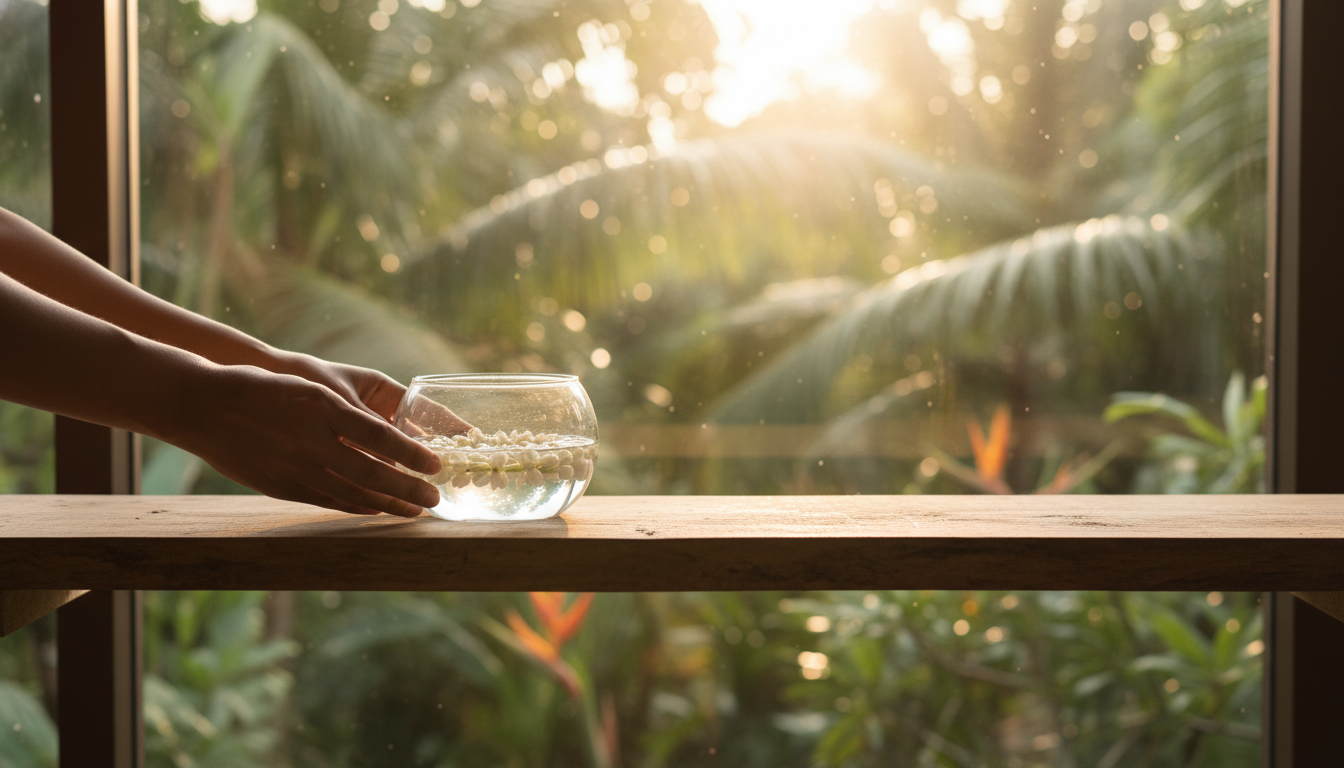
- The Water Ritual: Every morning, place a fresh bowl of water on your altar. Water is a massive conductor of energy. It absorbs the “static” from the atmosphere. In the evening, pour that water onto a living plant outside. Do not pour it down the drain. This recycles the energy back into the earth.
- The Incense Shield: Lighting three sticks of incense represents the Buddha, the Dhamma (the law), and the Sangha (the community). As the smoke rises, visualize it filling every corner of the room, acting as a “smoke screen” that hides your home from negative influences.
- The Threshold Salt: If you feel a specific negative presence or have had a “heavy” visitor, sprinkle a mixture of sea salt and crushed chilies across your doorstep. In Thai folk magic, this is used to “burn” the feet of any entity that has no business being in your space.
The Master of the House is You
All these tools—the Spirit Houses, the Yantras, the amulets—are secondary. The primary occupant of your home is your own consciousness. If you are a fragmented, fearful person, you are inviting fragmentation and fear into your space. The most powerful “occult” practice is to remain centered. If you are in a state of Samadhi, or even just deep internal balance, your very presence becomes a shield. No ghost, no curse, and no “bad luck” can find a foothold in a person who is truly awake.
Thai rituals are designed to support you, not to do the work for you. They create a “clean lab” so that you can go about the business of living without being constantly distracted by the “unseen bacteria” of the energetic world. Treat these practices with respect, not because a god will punish you, but because the laws of energy are as unforgiving as the laws of gravity. If you walk off a cliff, you fall. If you disrespect the occult forces you have invited into your home, you will face the consequences of that imbalance.
Setting Up Your First Protection Altar
If you want to begin, do not go out and buy twenty different statues. Start with one. Find a representation of a protective force that resonates with you—perhaps a Luang Phor Sothon or a Thao Wessuwan. Place it in the highest point of your main living area. Keep it clean. Every day, for five minutes, sit in silence in front of it. This is not “prayer” in the sense of begging for favors. This is “alignment.” You are aligning your personal energy with the quality represented by the image. Once you are aligned, the protection is automatic. You don’t have to ask for it any more than you have to ask the sun to shine. It is simply the nature of the thing.
The “forbidden” guide is only forbidden to those who are irresponsible. For the one who seeks to live life with awareness, these ancient Thai practices are simply part of the manual for being human. You have been given a body, a mind, and a space to live in. It is your responsibility to manage them well. If you don’t, someone or something else will. That is the only real “secret” of the occult.