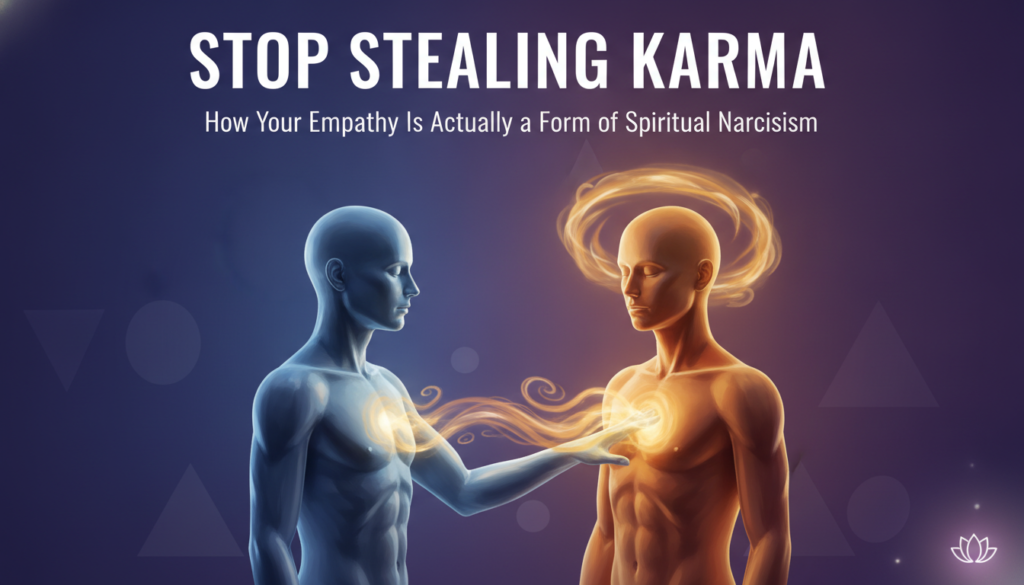
Ah, empathy. The cherished jewel of human connection, the cornerstone of virtue. Or is it? Let’s peel back this sacred cow, this universally lauded trait, and examine what truly lies beneath its gleaming surface. What if your earnest desire to “feel” another’s pain, to “share” their burden, is not the pure act of love you imagine, but rather a subtle, insidious form of spiritual self-indulgence? Prepare to be provoked, for we are about to journey into a truth that may unsettle your most comforting assumptions.
The Echo Chamber of Suffering: Empathy as Identification
You encounter someone in distress, and immediately, your heart goes out to them. You feel their sorrow, their anger, their helplessness. You tell yourself, “I am empathizing.” But look closer. Are you truly connecting with them, or are you merely projecting your own past experiences, your own fears and anxieties, onto their situation? What you call empathy is often a profound act of identification, where you essentially double the suffering by internalizing it. You are not helping; you are merely becoming part of the problem, adding another trembling soul to the collective pool of misery.
When you say, “I feel your pain,” what you are often unconsciously saying is, “I am so sensitive, so virtuous, that I can absorb your suffering.” This is not compassion; this is an ego trip. True compassion does not identify with suffering; it recognizes the suffering, holds space for it, but remains untouched by its contagion. It acts from a place of inner stability, not emotional entanglement.

The Illusion of Rescue: Stealing Another’s Lesson
Life, in its infinite wisdom, presents each being with a unique set of circumstances, challenges, and lessons. This is karma unfolding. Each tear, each struggle, each moment of despair is a meticulously crafted opportunity for growth, a necessary crucible for transformation. When you rush in with your self-proclaimed empathy, eager to alleviate their struggle, to “fix” their situation, are you truly serving them, or are you intervening in their spiritual curriculum?
By trying to shoulder their burden, you are not just relieving them of pain; you are potentially robbing them of their necessary learning. You are, in essence, trying to steal their karma. This is a profound misunderstanding of existence. Everyone must face their own fire, forge their own steel. Your “help” born of emotional identification often becomes a spiritual bypass, preventing the very maturation process that suffering is designed to ignite. You may feel like a savior, but you are often merely a meddler, obstructing the divine design.
The Narcissism of the Savior Complex
Consider the inner mechanics of this “empathy.” When you dive headfirst into someone else’s emotional drama, what is the underlying payoff for you? Is it not a subtle validation of your own ‘goodness’? A reinforcement of your self-image as a caring, compassionate individual? You get to feel important, indispensable, morally superior. This is the hallmark of spiritual narcissism: using another’s predicament as a mirror to reflect your own perceived virtue. Your desire to help often stems from an unconscious need to be needed, to be seen as the benevolent one, rather than a genuine, detached outpouring of grace.
This is why so many “empaths” find themselves perpetually exhausted, drained, and resentful. They are not giving from a place of abundance; they are constantly drawing on their own limited emotional reserves, identifying so deeply that they become burdened. True giving flows from an inexhaustible source within, a state of joyful exuberance that doesn’t diminish, but rather expands with every act.

From Empathy to True Compassion: The Path of Awareness
So, if empathy as we commonly understand it is a trap, what is the alternative? The alternative is true compassion. Compassion is not an emotion; it is a state of being. It arises not from identification with suffering, but from a profound inner silence, a deep well of peace and joy within yourself. When you are rooted in this inner space, you perceive the suffering of others without becoming entangled in it.
- Compassion observes: It sees clearly, without judgment or emotional reaction.
- Compassion empowers: It acts from a place of strength, offering a stable presence and guiding towards solutions, rather than absorbing problems.
- Compassion liberates: It helps others find their own strength, allowing them to face their karma and grow, rather than carrying it for them.
- Compassion is a consequence of inner work: It’s not something you “do”; it’s something that naturally overflows when your own being is purified and aligned.
When your own cup is overflowing with bliss and clarity, a spontaneous outpouring of love and wisdom occurs. This is not driven by neediness, either yours or theirs, but by an abundance that seeks expression. You become a conduit for grace, not a sponge for pain.

The Call to Inner Mastery
The time has come to stop mistaking emotional drama for spiritual depth. Stop using others’ pain as a mirror for your own egoic virtue. Your primary spiritual responsibility is not to solve the world’s problems, but to become a problem-free being yourself. To cultivate such a profound inner stillness, such an unwavering joy, that your very presence becomes a blessing, a stable point in a turbulent world.
Only when you transcend the petty play of identification and projection, only when you establish yourself in the unshakeable core of your being, can true compassion arise. Then, you don’t steal karma; you illuminate the path. You don’t get drained; you become an endless source. This is the real revolution: turning your gaze inward, transforming yourself, and in doing so, offering the world a genuine beacon of light, rather than another reflection of its own shadows.