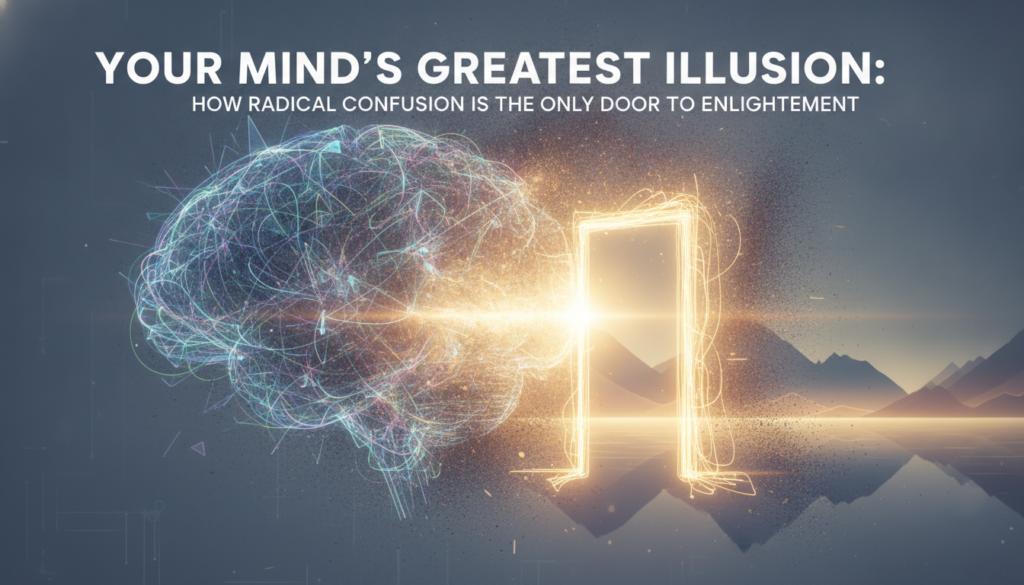
The human mind is relentlessly drawn to clarity, certainty, and definitive answers. We seek to understand, to categorize, to label, believing that a perfectly ordered mental landscape is the ultimate goal. We are taught that knowledge is power, and ignorance is a state to be overcome. Yet, what if this very pursuit of unshakeable clarity is the most profound illusion, a cleverly constructed barrier preventing access to deeper truth? What if the path to true insight lies not through the acquisition of more knowledge, but through its radical dissolution?
The Mind’s Elaborate Prison of Knowing
From birth, our minds are trained to construct a coherent reality. We build frameworks of understanding, adopting beliefs, facts, and narratives that give us a sense of stability and control. This process creates what we perceive as ‘our world’ and ‘our self.’ But this intricate mental structure, while useful for navigating daily life, inevitably becomes a prison.
We become identified with these mental constructs. Our opinions, our knowledge, our understanding of ‘how things are’ become our identity. We cling to these certainties, defending them fiercely, because their collapse feels like the collapse of our very being. This constant mental activity, this striving for perfect understanding, keeps us perpetually engrossed in the limited play of our own thoughts.
The mind, in its cleverness, convinces us that the absence of confusion is the presence of truth. It offers tidy explanations, logical sequences, and comforting narratives. But these are often just reflections of its own programming, not glimpses into the vastness of existence beyond its grasp.

Radical Confusion: Not Mere Indecision
When we speak of radical confusion, we are not talking about simple indecision or being momentarily puzzled by a difficult problem. This is a much deeper phenomenon. Radical confusion is the state where your entire mental framework begins to unravel. It is when the ground beneath your feet disappears, and everything you thought you knew, everything you believed, and everything you identified with, loses its coherence.
This state is terrifying for the ego. The ego thrives on definition, on clear boundaries, on a stable sense of ‘who I am’ and ‘what I know.’ When these pillars begin to crumble, there is an intense feeling of disorientation, even terror. It feels like a loss of control, a descent into madness.
Most people, when faced with such an experience, immediately seek to rebuild. They search for new certainties, new beliefs, new systems to re-establish a sense of order. But this impulse, while natural, is precisely what keeps the door to deeper understanding closed.
The Necessity of Mental Breakdown
- Beyond Logic’s Reach: The logical mind can only operate within known parameters. It processes information, analyzes, and synthesizes, but it cannot grasp that which is fundamentally new, that which exists beyond its own conceptual boundaries. To truly perceive something novel, the old structures must temporarily cease to function.
- Dissolving the Ego: The ego is a bundle of identifications. It says, “I am this, I believe that, I know this.” Radical confusion shatters these identifications. When you don’t know who you are, what you believe, or what is true, the ego’s grip loosens.
- Opening to the Unknown: As long as you ‘know,’ you are closed to new possibilities. The moment of not-knowing, of profound confusion, creates an opening. It is an emptiness, a void, into which something entirely new can arise, something the mind could never have conceived.
Embracing the Void: The True Act of Courage
The real courage on this path is not in seeking answers, but in sustaining the state of not-knowing. It is in being willing to sit in the radical confusion, to feel the terror and disorientation, without immediately scrambling for a new mental anchor. It is about allowing the old structures to truly collapse, without resistance.
This is a process of unlearning, of stripping away layers of conditioning, not adding more to them. It demands a surrender to the unknown, a willingness to be utterly lost in the vastness of an un-conceptualized existence.
In that profound state of confusion, where the mind’s ceaseless chatter and attempts to define have momentarily ceased, a different kind of space opens up. It is not clarity in the way the mind understands it—a clear picture of facts and definitions. Instead, it is a clarity that transcends definition, a seeing that is beyond thought.
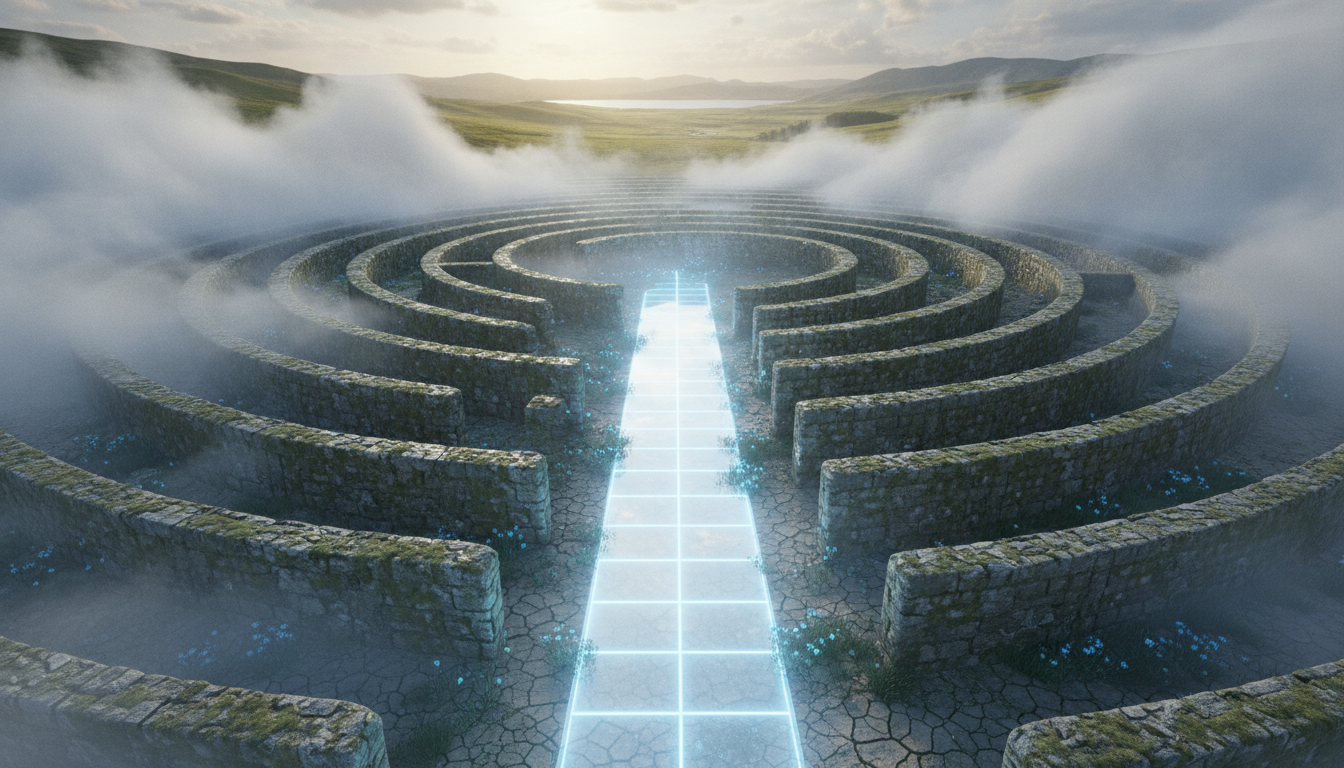
The Door Swings Open
Enlightenment is not about gaining a final, perfect answer that makes everything clear forever. It is not about reaching a state where confusion is impossible. In fact, it might be the realization that the mind’s need for absolute clarity and certainty was the very illusion preventing true insight.
When you have allowed the radical confusion to strip away all your preconceived notions, all your carefully constructed beliefs, and all your identifications, what remains is the raw, unadulterated essence of being. In that space, there is no confusion because there is no mind left to be confused. There is simply presence, a vast awareness that observes without judgment or the need to categorize.
This is the enlightenment: not the absence of questions, but the realization that you are not the one asking the questions, nor the one needing the answers. You are the space in which questions and answers, clarity and confusion, arise and dissolve. Radical confusion, therefore, is not an obstacle on the path, but the path itself. It is the necessary breakdown that allows you to see beyond the mind’s greatest illusion and step into the boundless reality of what is.