Ah, the noble act of helping! It’s adorned with halos, celebrated in scriptures, and etched into the very fabric of what we deem “goodness.” But let us pause, for a moment, and peel back the layers of this virtuous onion. What if much of what we call altruism is, in reality, a sophisticated masquerade? What if the outstretched hand is not merely giving, but subtly grasping for something far more vital to the inner apparatus of our being – the sustenance of the self?
The Subtle Hunger of the Self
The ego is a peculiar beast. It doesn’t always demand thrones or vast fortunes; sometimes, its most voracious appetite is for validation, for significance, for the sweet nectar of being perceived as “the good one.” When you rush to someone’s aid, when you offer your wisdom, your time, your resources, are you truly acting from an unbound space of compassion, or is there a quiet calculation happening within, a subtle ledger being balanced?
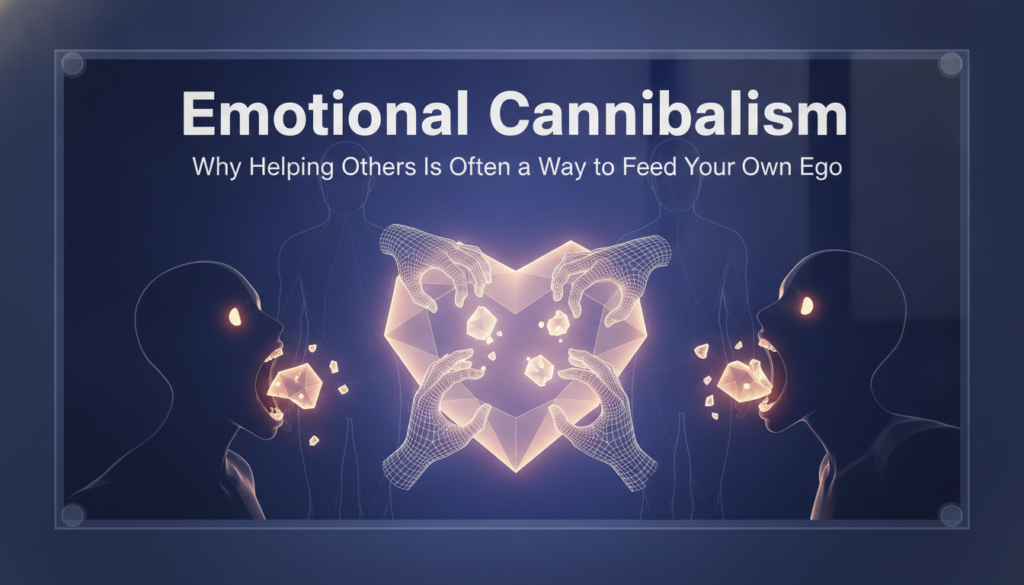
Consider the inner glow, the sense of accomplishment, the silent pat on the back you give yourself after a perceived act of kindness. This is not to condemn that feeling, but merely to observe its presence. This feeling, this bolstering of your self-image, is the ego’s meal. It’s emotional cannibalism: you consume the validation, the gratitude, the perceived moral superiority derived from another’s need, to feed the insatiable hunger of your own self-importance.

The Mask of Virtue
Society, in its collective blindness, often reinforces this insidious dynamic. We build pedestals for those who “help.” We laud their generosity, their selflessness, their sacrifice. This societal praise becomes a powerful stimulant for the ego. Who wouldn’t want to wear the mask of virtue when it earns such rich dividends of appreciation and admiration?
But true compassion, authentic giving, requires no audience, no accolades, no reciprocal energy. It is an overflow, a natural showering, like a cloud raining without concern for whose fields it irrigates. Most of what passes for compassion, however, is a carefully orchestrated transaction where the subtle currency is ego-nourishment. Observe these telling signs:
- The need to be seen as good: Do you find yourself subtly ensuring others are aware of your benevolent actions?
- The feeling of superiority: Does helping another subconsciously place you on a higher rung, affirming your capabilities against their perceived lack?
- The desire for gratitude: Do you feel a tinge of disappointment or even resentment if your efforts are not acknowledged or if the recipient doesn’t express sufficient thanks?
The Trap of Identification
Your ego loves roles. It loves to be the “savior,” the “mentor,” the “giver.” This role becomes a part of your identity, a comfortable garment you wear. The moment you identify with “the helper,” you become bound by it. Your existence starts to derive meaning from the act of helping. It’s a subtle but powerful addiction.
What happens when the person you are helping becomes self-sufficient? What happens when they no longer need you? Do you feel a strange sense of loss, a void? That void is not for the person; it is for the role you played, for the ego-food that is now withheld. You were not helping them for their liberation, but for your own subtle enslavement to the identity of being a helper.

The Transactional Nature of “Good Deeds”
Look deeper. Most “good deeds” are not an offering but a transaction. You give something – money, advice, time – and in return, consciously or unconsciously, you expect something back. It could be gratitude, admiration, a boost to your self-esteem, or even a future favor. This is not service; it is a sophisticated form of bartering, disguised under the noble cloak of altruism. When you act from such a transactional space, you bind yourself further into the endless cycle of expectation and disappointment, of giving and taking, never truly free, never truly overflowing.
Towards an Egoless Offering
So, is all help tainted? Must we retreat into hermitages to avoid this trap? Not at all. The invitation is not to cease helping, but to shift the locus of your action. It is to move from “doing” to “being,” from a calculated act to an organic expression. True compassion doesn’t arise from a sense of duty or a desire for validation; it arises from a deep, non-dual understanding that you are not separate from the other.
When you act from an egoless space, your helping is not an effort to gain something, not even the feeling of being good. It is simply a response, a natural flow of energy from one part of existence to another. There is no ‘I’ who helps, and no ‘you’ who is helped. There is only life responding to life. This is where true impact lies, where transformation genuinely occurs, both for the giver and the receiver.
- Action without expectation of outcome: You do what is needed, not what will garner praise or self-satisfaction.
- Seeing the other not as someone “lesser”: There is no sense of superiority, only recognition of shared humanity or shared existence.
- Inner stillness that allows action to flow spontaneously: Your actions arise from a place of deep inner peace, not from a driven urge to fulfill a role or feed a need within yourself.

The Alchemy of Awareness
The key to transcending emotional cannibalism is not to stop acting, but to become profoundly aware of your inner motivations. Observe, without judgment, the subtle stirrings within you when you reach out to help. Is it an overflow of love, or is it a hidden agenda for self-enhancement? This act of observation itself is transformative. When you shine the light of awareness on your ego’s machinations, its power begins to dissolve.
This alchemy of awareness transforms what was once a binding transaction into an act of true liberation – for yourself, and by extension, for all around you. It allows you to become a conduit for life, rather than a consumer of it.
So, before you extend that hand, take a moment. Inquire within: who is truly helping whom? And for what purpose? Only when you unravel the ego’s cunning dance can your actions become truly profound, truly liberating, and truly in service to something far vaster than your own little self.