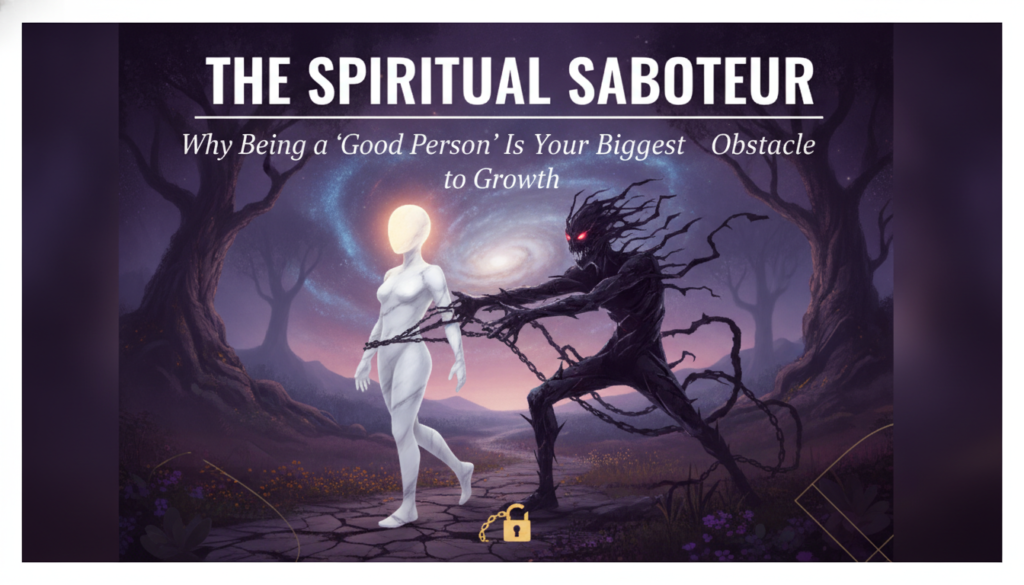
We are conditioned from birth to strive for a particular ideal: to be a ‘good person.’ This aspiration is so deeply ingrained, so universally praised, that to question it feels almost sacrilegious. Yet, what if this very quest for goodness, as defined by the world around us, is not a gateway to spiritual liberation, but an intricate, self-forged prison? What if the spiritual journey demands that you shed this well-polished identity, rather than embrace it? This is the paradox of the spiritual saboteur.
The Performance of Morality: A Golden Cage
For most, ‘goodness’ is a blueprint handed down: a set of rules, dogmas, and societal expectations. It’s about being polite, obeying laws, adhering to religious tenets, and avoiding actions deemed ‘bad.’ This isn’t about an inner blossoming; it’s about external conformity. You are lauded for how well you fit into the mold, for how perfectly you perform the role of the ‘good citizen,’ the ‘devout believer,’ the ‘moral individual.’ But this performance, however convincing, keeps you perpetually on the surface of your being, never truly diving into the depths of who you are.
The Fear of the Unseen Bad
Why do we cling so desperately to this identity of goodness? Often, it’s a profound fear. A fear of judgment, of rejection, of divine retribution, of being cast out from the warm embrace of societal approval. This fear becomes the engine of our morality. We don’t act ‘good’ because it flows naturally from our being; we act ‘good’ to avoid the terrible consequences of being perceived as ‘bad.’ This isn’t freedom; it’s a constant self-policing, a tightrope walk over the imagined abyss of our own ‘darkness.’ How can you ever truly know yourself, truly expand, when your every action is dictated by an internal fear-based censor?
The Burden of Expectation
Maintaining the persona of a ‘good person’ is an exhausting affair. It demands constant vigilance, a careful curation of words, thoughts, and deeds. There’s little room for spontaneity, for authentic expression, for the raw, untamed aspects of your being that spiritual growth often demands. You become a prisoner to others’ expectations, perpetually gauging your actions against an external barometer. When your existence becomes about fulfilling an image, you are not living; you are merely performing. And a performance, however brilliant, can never bring you true liberation.

Beyond Good and Evil: The Territory of Truth
True spiritual work is not about ascending a ladder of virtues. It is about dissolving the very structures that define such ladders. It’s about transcending the dualities of good and evil, right and wrong, that are purely constructs of the human mind and its conditioning. The cosmos itself does not operate on these moral codes; it simply is. To touch the truth of existence, you must step beyond these mental fences.
Awakening to Authenticity
What if true goodness isn’t something you strive for, but something that arises naturally when you shed the performance? When you stop trying to be ‘good’ and instead focus on becoming utterly conscious, utterly aware, an authentic decency begins to blossom. It’s not a moral code you follow; it’s a consequence of a heightened state of being. When your inner space is clear, when you are simply present, your actions become naturally aligned with the wellbeing of all. There’s no effort, no struggle, just a spontaneous flow of life.
The Freedom of No Identity
To truly grow, you must be willing to let go of every identity you cling to, even the cherished one of being a ‘good person.’ Imagine the lightness, the radical freedom that comes when you are no longer defined by labels, no longer bound by societal judgments. This isn’t about becoming ‘bad’; it’s about becoming boundless. It’s about realizing that your essence is far beyond the small, constricted definition of morality. Only in this space of no-identity can true transformation begin.

The Path of Conscious Living, Not Moral Living
The journey is not about accumulating virtues, but about cultivating awareness. It’s about engineering your inner space so profoundly that the question of ‘good’ or ‘bad’ becomes irrelevant. Your actions then arise not from a fear of breaking a rule, but from a deep, unwavering clarity and responsibility for your own experience and the world around you.
From Reactivity to Responsiveness
A ‘good person’ often reacts to situations based on their conditioning, their learned moral compass, their fear of being judged. A conscious being, however, responds. There’s a space between stimulus and response, a space where awareness resides. In this space, you choose your response not from programmed reaction, but from a profound understanding of the situation and an inner clarity that transcends conventional morality. This is the difference between living by rote and living by conscious choice.
The Compassion of Awareness
True compassion isn’t a moral imperative; it’s a natural outpouring of an aware existence. When you realize the interconnectedness of all life, when you understand that the other is not truly ‘other,’ but an extension of the same universal fabric, compassion arises not as an effort, but as an inherent quality. It’s not something you do to be ‘good’; it’s simply how you are when you are fully present and conscious. This is a compassion that flows without judgment, without conditions, without the need for reciprocal validation.

So, perhaps it’s time to stop striving to be a ‘good person’ and start daring to be an authentic, conscious human being. Shed the gilded cage of morality, drop the burden of expectation, and step into the boundless territory of your true nature. Only then can you transcend the spiritual saboteur and truly begin to grow, not into a better version of what others expect, but into the magnificent, unconditioned being you were always meant to be.